EV Charging Stations in Pakistan: How to Find and Use a Public Charger
Finding a working charger is the biggest practical question for anyone considering an electric car in Pakistan. The public network is growing but still small, so the smartest approach is to charge mostly at home and treat public DC chargers as a backup for longer trips. This guide explains the types of chargers you will meet, who operates them, how to check one is working, and what the government has planned.
How many EV charging stations does Pakistan have?
Public charging is concentrated in Karachi, Lahore and Islamabad/Rawalpindi, with a growing number of sites on the motorways. Count estimates vary by source because new sites open, some are private or dealer-only, and not all are listed on apps. Treat any map as a starting point, not proof that a charger is available today.
Government policy aims to grow this quickly. The New Energy Vehicles Policy 2025–30 ↗ says the National Highway Authority will set up forty fast (Level 3) charging stations along all motorways and selected sections of the N-5, about 120 km apart, and targets 3,000 charging points of all types by 2030.
Types of chargers you will find
| Charger type | Typical power | Where you find it | Adds roughly |
|---|---|---|---|
| Wall socket (portable cable) | 2–3 kW | Home, office | A few km of range per hour |
| AC wallbox (Type 2) | 7–11 kW | Home, hotels, malls, dealers | 30–50 km per hour, depending on the car |
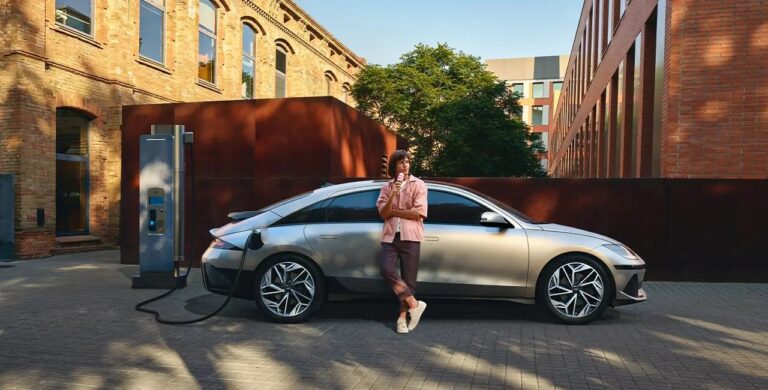
| DC fast charger (CCS2) | 50–160 kW | Motorway service areas, fuel stations, dealers | Most cars reach 80% in 30–60 minutes |
How fast a car actually charges depends on the car as much as the charger. See each model’s published DC charging window in our EV database.
Who operates chargers in Pakistan?
Public chargers are run by a mix of fuel companies, private charging operators, hotels, and car brands. A PakWheels motorway guide (April 2026) ↗ lists sites operated by PSO, Hascol, Petropak and others, including fast chargers at Bhera on the M-2 and Kharian on the N-5. BMW’s importer Dewan Motors also announced a DC charger at Bhera ↗. Charging operators are licensed and regulated under NEECA’s EV charging regulations.
How to check a charger before you rely on it
- Confirm the connector. Most new EVs sold here use CCS2 for DC fast charging and Type 2 for AC. Imported Japanese used EVs may use CHAdeMO or Type 1 instead.
- Call ahead or check the operator’s app. Ask whether the charger is working, its opening hours and whether it is reserved for a brand’s customers.
- Ask about payment. Operators may use cards, wallets, apps or cash. Confirm before the trip.
- Have a plan B. Keep enough charge to reach an alternative charger or your destination if the first one is busy or out of service.
- Check the price per kWh. Public DC charging usually costs more than home charging.
How much does public charging cost?
Operators set their own prices, so check each one. Under the NEV policy, commercial charging stations get a fixed electricity tariff of PKR 39.7 per kWh, which is intended to keep charging affordable while letting operators make a margin. The price you pay at the charger will be higher than that tariff. Our EV cost per km guide shows how to turn any per-kWh price into a cost per kilometre.
Planning a motorway trip
- Plan around your longest leg between reliable chargers, not the total distance.
- Use a conservative range: summer heat, air conditioning and 120 km/h cruising all reduce range. See real-world EV range in Pakistan.
- Arrive with a buffer of at least 15–20%.
- Charge to around 80% at fast chargers; the last 20% is much slower.
Why we have not published a station map yet
Out-of-date charger maps are a common frustration. We will add a station directory only when each location and operator has been verified. Until then, use operators’ own apps and call ahead.
Frequently asked questions
Where can I charge an electric car in Pakistan?
At home with a wall socket or wallbox, and at public AC and DC chargers run by fuel companies, private operators, hotels and car brands, mostly in major cities and on the M-2 and N-5.
Are EV chargers in Pakistan free?
Some hotel, mall or dealer chargers may be free for customers, but most public DC chargers charge per kWh. Confirm the price with the operator.
What connector do EVs in Pakistan use?
Most new EVs sold by Pakistani distributors use CCS2 for DC fast charging and Type 2 for AC charging. Imported used Japanese EVs may use CHAdeMO.
How long does it take to charge an EV at a fast charger?
Many cars charge from about 30% to 80% in 30 to 40 minutes on a suitable DC charger, but the car’s maximum charging power and the charger’s output both matter.