EV vs HEV vs PHEV vs REEV: Electric Car Types Explained for Pakistan
Shopping for an electric car in Pakistan means decoding a lot of abbreviations: EV, BEV, HEV, MHEV, PHEV, REEV and FCEV. They all use an electric motor somewhere, but they differ in one big way: what actually turns the wheels, and whether you plug in to charge. This guide explains each type in plain language, with examples sold in Pakistan, so you can pick the one that fits your routine.
Quick answer
- EV / BEV (battery electric vehicle): battery and electric motor only. You plug in. No petrol.
- HEV (hybrid electric vehicle): petrol engine plus a small battery. You cannot plug in; the car charges itself.
- PHEV (plug-in hybrid): petrol engine plus a larger battery you can plug in, for short electric-only trips.
- REEV (range-extended EV): the electric motor always drives the wheels; a petrol engine recharges the battery when it runs low.
- MHEV (mild hybrid) and FCEV (hydrogen fuel cell) are less common; both are explained below.
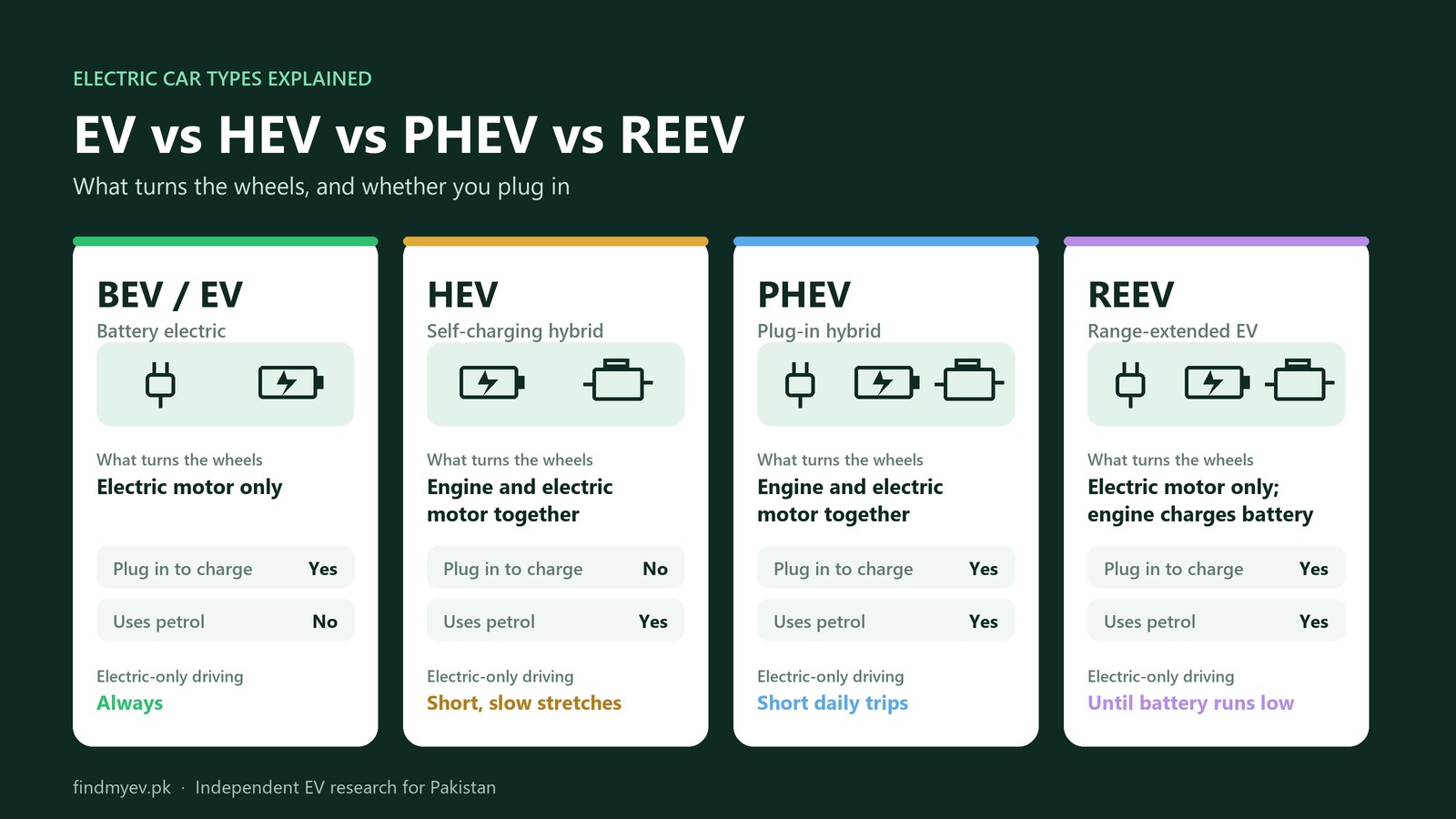
EV types compared at a glance
| Type | Plug in to charge? | Uses petrol? | What turns the wheels | Electric-only driving | Examples in Pakistan |
|---|---|---|---|---|---|
| BEV / EV | Yes | No | Electric motor | Always | BYD Atto 3, MG4 EV, Kia EV5, Deepal S07 |
| HEV | No | Yes | Engine and electric motor | Short, slow stretches | Toyota Prius Hybrid, Hyundai Tucson Hybrid, MG ZS Hybrid+ |
| PHEV | Yes | Yes | Engine and electric motor | Short daily trips | BYD Shark 6, MG HS PHEV, Kia Sorento PHEV |
| REEV / EREV | Yes | Yes | Electric motor (engine charges battery) | Until the battery runs low | Deepal S05 REEV |
| MHEV | No | Yes | Engine, with a small electric assist | None | Not covered in our database |
| FCEV | No (refuel with hydrogen) | No | Electric motor | Always | Not officially sold here |
Examples were checked on the Pakistan distributor websites on 24 September 2026. Availability and variants change, so confirm with a dealer.
EV or BEV: battery electric vehicle
A battery electric vehicle, usually just called an EV, has no petrol engine at all. A large battery (typically 30 to 100 kWh) powers one or more electric motors. You charge it from a wall socket or wallbox at home, or at a public DC fast charger on a journey.
Pros
- Lowest running cost per kilometre when charged at home. See EV cost per km in Pakistan.
- No petrol, no oil changes and far fewer moving parts to service.
- Quiet, smooth and quick, with zero tailpipe emissions.
Cons
- You need reliable charging, ideally overnight at home.
- Long intercity trips need planning around public chargers. See real-world EV range.
- Higher purchase price than a similar petrol car.
Battery EVs sold in Pakistan include the MG Binguo EV, MG4 EV Urban, BYD Atto 2, BYD Atto 3, BYD Seal, Deepal L07, Deepal S07, Deepal E07, Kia EV5, Kia EV9, Hyundai IONIQ 5 and Hyundai IONIQ 6. Compare prices, range and charging for all of them in our EV database.
HEV: hybrid electric vehicle (self-charging hybrid)
A full hybrid combines a petrol engine with an electric motor and a small battery, usually around 1 to 2 kWh. The battery is charged by the engine and by regenerative braking, which turns the car’s momentum back into electricity when you slow down. There is no charging port.
At low speeds, in traffic or when parking, an HEV can move on electricity alone for short distances. At higher speeds the engine does most of the work, with the motor helping to save fuel. This makes hybrids most efficient in stop-start city traffic.
Pros and cons
- Better fuel economy than a similar petrol car, especially in city traffic.
- No change to your routine: fill up with petrol as usual, no charging needed.
- Still burns petrol on every trip, and cannot run on grid electricity.
Examples in Pakistan: Toyota Camry Hybrid and Prius Hybrid (Toyota Indus ↗), Hyundai Elantra Hybrid, Tucson Hybrid, Santa Fe Hybrid and Palisade Hybrid (Hyundai Nishat ↗), and the MG ZS Hybrid+ (MG Pakistan ↗).
MHEV: mild hybrid
A mild hybrid adds a small electric motor-generator (often on a 48-volt system) to a petrol engine. It smooths engine start-stop, recovers some braking energy and gives a small boost when accelerating. It cannot drive the car on electricity alone, so fuel savings are modest. Think of it as an efficient petrol car rather than an electric one.
PHEV: plug-in hybrid electric vehicle
A plug-in hybrid works like a hybrid but has a much larger battery that you can charge from a socket or charger. On a full charge it can typically cover a few dozen kilometres on electricity alone, enough for many daily commutes. When the battery runs low, it switches to hybrid mode and uses petrol.
Pros and cons
- Electric driving for short daily trips, petrol for long journeys with no range worries.
- Lower fuel cost than a hybrid, but only if you plug it in regularly.
- You pay for, maintain and carry both an engine and a sizeable battery, so it is usually heavier and more expensive.
- Electric-only range figures are laboratory results; real range is lower with air conditioning and motorway speeds.
Examples in Pakistan: the BYD Shark 6 PHEV pickup (BYD Pakistan ↗), MG HS PHEV (MG Pakistan ↗) and Kia Sorento PHEV (Kia Lucky Motors ↗).
REEV or EREV: range-extended electric vehicle
In a range-extended EV, the wheels are always driven by the electric motor, just like a battery EV. The difference is a small petrol engine that acts only as a generator: when the battery runs low, the engine starts and produces electricity to keep you moving. Because the engine does not drive the wheels directly, a REEV feels like an EV to drive.
Pros and cons
- Drives like an EV, with electric-only range for daily use when charged at home.
- No range anxiety on long trips, because you can refuel with petrol.
- Once the battery is depleted, fuel economy depends on the engine and generator and is usually worse than a good hybrid on the motorway.
- Still needs engine servicing, so it does not bring the full maintenance savings of a battery EV.
Example in Pakistan: the Deepal S05 REEV, which Deepal Pakistan lists at PKR 9,999,000 (Deepal S05 ↗). REEVs are also called EREVs (extended-range electric vehicles).
FCEV: fuel cell electric vehicle
A fuel cell EV is driven by an electric motor, but instead of charging a battery from the grid, it generates electricity on board from hydrogen stored in high-pressure tanks. The only tailpipe emission is water vapour, and refuelling takes minutes. The catch is infrastructure: FCEVs need hydrogen filling stations, and we are not aware of any public hydrogen refuelling in Pakistan, so they are not a practical choice here yet.
Which EV type is right for you in Pakistan?
- You can charge at home and mostly drive in the city: a battery EV usually gives the lowest running cost and the least maintenance.
- You can charge at home but regularly drive long intercity routes: a battery EV with enough real-world range for your longest leg, or a PHEV or REEV for more flexibility.
- You cannot charge at home: a self-charging hybrid (HEV) saves fuel with no change to your routine. A plug-in only makes sense if you have reliable workplace or public charging.
- You face waterlogged roads in monsoon: no powertrain type makes a car safe in floodwater. Read EVs in Lahore rain and waterlogged roads.
Not sure yet? Enter your budget, daily distance, longest trip and charging access in our Find My Match tool, or work through the EV buying checklist.
Key EV terms explained
- kWh (kilowatt-hour): battery capacity, like the size of a fuel tank. A bigger number usually means more range.
- kW (kilowatt): power. For charging, it is how fast energy flows in; for motors, how powerful they are.
- AC and DC charging: AC is slower home or workplace charging through the car’s onboard charger; DC fast charging bypasses it for much quicker top-ups. See EV charging in Pakistan.
- CCS2: the most common DC fast-charging connector on EVs sold in Pakistan. Always check the connector before relying on a charger.
- Regenerative braking: the motor acts as a generator when slowing down, putting energy back into the battery.
- V2L (vehicle-to-load): lets the car’s battery power external devices, such as a laptop or small appliance.
- NEDC, CLTC and WLTP: laboratory test cycles used for range claims. They are not directly comparable. See real-world EV range.
Frequently asked questions
What is the difference between EV and HEV?
An EV (battery electric vehicle) runs only on electricity from a battery you charge by plugging in, and has no petrol engine. An HEV (hybrid electric vehicle) runs on petrol and uses a small battery and electric motor to save fuel; you cannot plug it in.
Is a PHEV better than a hybrid?
A PHEV can cover short daily trips on electricity if you charge it regularly, so it can use much less petrol than a regular hybrid. If you rarely plug it in, it behaves like a heavier hybrid and the extra cost may not pay off.
What does REEV mean?
REEV stands for range-extended electric vehicle. An electric motor always drives the wheels, and a small petrol engine works as a generator to recharge the battery when it runs low. The Deepal S05 REEV is an example sold in Pakistan.
Which type of electric car is best for Pakistan?
It depends on charging access. With reliable home charging and mostly city driving, a battery EV usually has the lowest running cost. If you drive long intercity routes with limited charging, a PHEV, REEV or hybrid avoids range anxiety at the cost of using petrol.
Can I charge a hybrid car at home?
Only plug-in types can be charged at home: battery EVs, PHEVs and REEVs. A self-charging hybrid (HEV) or mild hybrid recharges its small battery from the engine and braking, and has no charging port.
About this guide
Find My EV’s database currently covers battery electric cars and SUVs only, so hybrids, plug-in hybrids and range-extended models are described here but not listed with prices. Read our methodology for how we source and label data.